An interview with QuickAds Head of Creatives Sanjeev Kumar and Performance Marketing Head Danish Ansari. They revealed something most designers and agencies aren't ready to hear: the job hasn't disappeared. It's just been completely redefined.
What's Inside:
- The hiring criteria have changed, not toward AI skills replacing design skills, but toward people who have both.
- The creative elements that drive conversions based on 30 million ads analyzed. Some might surprise you.
- A real case study with real numbers: 35 AI videos made, 22 outperformed the benchmark, and the ROAS more than doubled.
- How to pitch based on what brands look for in a creative portfolio, what the hiring assignment looks like, and why showing your thinking beats showing polished work.
- How brand consistency survives high-volume output, and what that means for the role designers and agencies play now.
If you work in design, run a creative agency, or are trying to land clients with real ad budgets, this is the clearest picture of what conversion looks like from the inside in 2026.
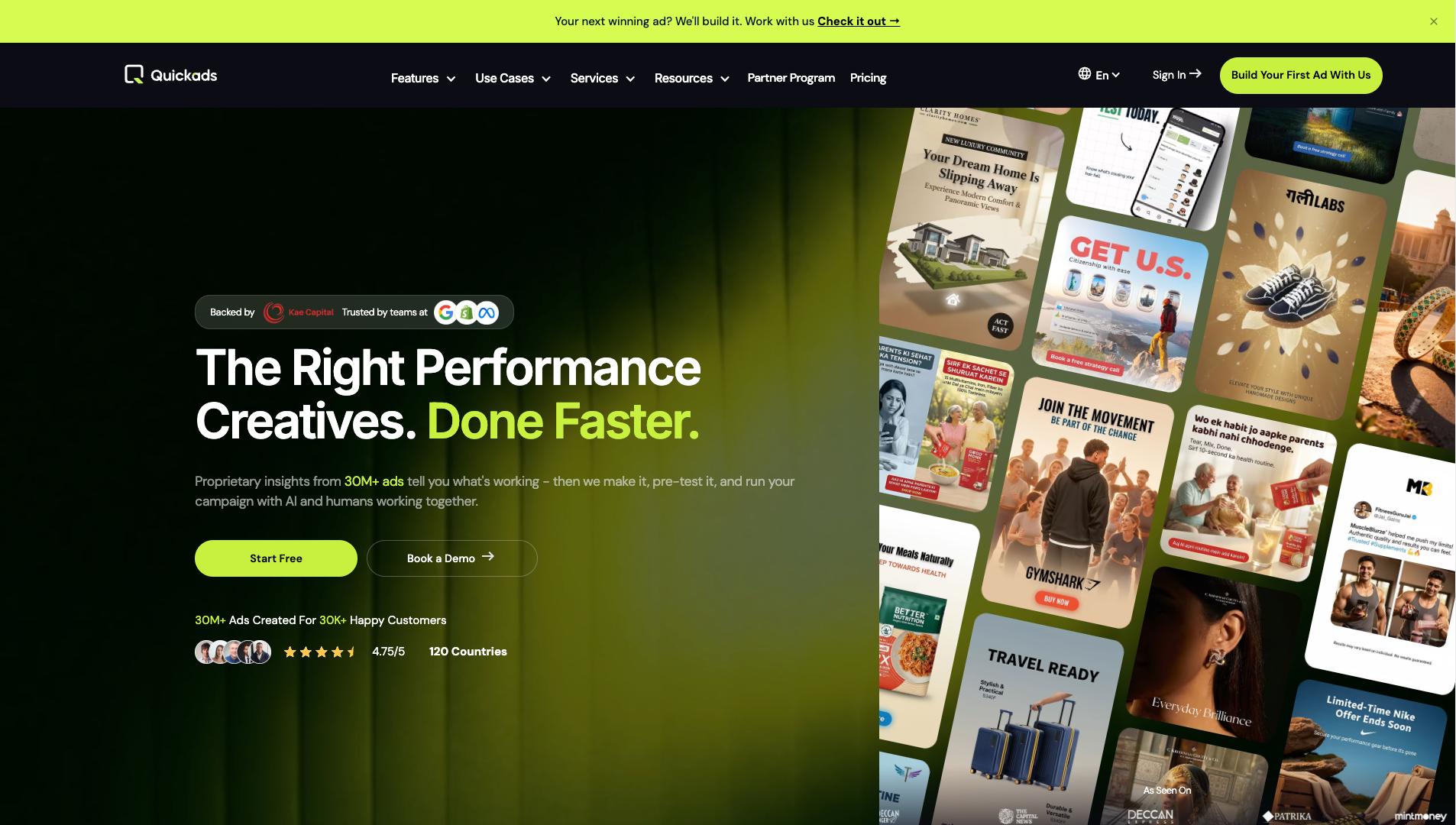
QuickAds produces up to 400 creatives a month for a single brand. They run 12 to 13 different ad formats simultaneously. They scaled one client's ad spend while more than doubling their ROAS, using AI-generated video as the primary creative engine.
80-85% of the time, their system can predict whether an ad will perform before it ever goes live. And one of the people leading their creative output is a college student who is studying pharmacy.
But here's what the leaders at QuickAds will tell you directly: they are not done hiring designers. They are not done working with agencies. What they are done with is the old version of both.
The World You're Selling Into Has Changed
Before you can land work with brands like QuickAds, or any brand operating at this level of speed and data, you need to understand how they actually think.
QuickAds isn't an agency in the traditional sense. It's three things at once:
- A creative analytics tool that scores ads before they run
- A campaign management platform that monitors performance on Meta and Google in real time
- A production engine that generates static ads, catalog ads, UGC-style video, and animated content at scale
All three are powered by a proprietary AI trained on 30 million creatives and connected to 25,000 live ad accounts.
When a brand brings them a brief, they don't start from scratch. They already know, from data, which hooks are working in that category, which formats are outperforming, and which angles have legs right now. What makes that system credible isn't just the volume of data, it's the hierarchy of it. Danish broke down exactly how their model gets trained:
"There are three ways we train our models. First is all the account data directly connected to our platforms: exact hook rate, exact hold rate, CAC, CPA, everything. This is the first-party data. We have around 25,000 accounts directly connected to Meta. Second is we scrape all the ad libraries available and we do modeling just similar to what the result we are seeing on our managed accounts. Third is we scrape social media. The first source of truth is actual account numbers connected with us. Second is the ad library. Third is social media."
And why does social media rank lowest?
"We are a performance marketing company. We create creatives for performance marketing. We don't do social media marketing."
That distinction, engagement versus conversion, is what the best creative agencies already understand instinctively. But having the data architecture to enforce it systematically is what separates QuickAds from teams still operating on gut feel and trend-watching.
What this means for you: The brands worth working with in 2026 are operating with this level of intelligence. When you pitch to them, you're not just selling taste. You're selling your ability to operate inside a system that moves fast, tests constantly, and changes every month. If your process looks the same as it did three years ago, you are falling behind.
The Three Core Skills That Get You Hired
Here is where QuickAds diverges most sharply from conventional hiring logic: they don't sort by seniority, Sanjeev shares.
"I won't say senior or junior. I'll say talent. I see a lot of seniors—they're not adapting to the AI part. The junior people, they have the fire to just change. If you see our team, a lot of junior people are just outshining everyone."
Case in point: the intern who came in from college, not a design school, but a pharmacy program, is now leading an entire team. Still enrolled. Still technically a student. Sanjeev continues,
"He's not even a design school person. He's doing pharmacy. That's what his dad wanted him to be. But he wanted to be a designer. So that's how things have opened up."
This isn't a feel-good story about raw talent triumphing over credentials. It's a signal about what competency actually looks like right now. When Danish and Sanjeev talk about what they're evaluating in a hire, three things come up every time:
- Can they think and visualize? Sanjeev is looking for people who can take a client brief and immediately translate it into a visual direction, not just execute instructions. He wants someone who can think and visualize, and also adapt to AI platforms.
- Can they use AI tools fluently, not just experimentally? This is the gap Sanjeev says he struggles most to fill right now. Strategic thinking, most people have, but AI fluency at a working level? Much rarer.
"The person who has strategy plus moving to AI…I'm still facing a lot of challenges finding them. The industry is still very new to this. People are still using a lot of ChatGPT and things like that. We've moved so far ahead, Claude and things like that, and that's one of the biggest challenges I'm facing."
- Can they work at speed? Danish is direct about the economics of iteration:
"For any business today, the biggest cost is the [production] token. If I hire a creative designer who takes 10 iterations to build a final product versus a designer who takes two—for me, the designer who can visualize things better, who thinks better so that my cost of production ultimately gets reduced—this is one of the things I look into."
What the hiring assignment actually looks like: They don't ask candidates to "design an ad for a nutrition brand." As Sanjeev shares, they present a real client problem and ask: what would you make, and why?
"We never say 'do a design for a nutrition brand.' We say: ‘this is the problem the client is coming up with. What kind of ads would you do for them?’ That's how we understand the thinking process."
In the interview itself, Sanjeev probes every decision, why that CTA button, why that hook, why that layout. And they time-box it deliberately.
"We give one day. Whatever you want, come back to us. We see if all the things are ticked or not."
Danish adds that the fundamentals are still a hard filter:
"If a designer comes to me and gives me some random color combination, I'm not going to hire them. I know their visual understanding is different. But if I ask them to create a very minimal brochure and they give me two or three palettes, then I know the designer is very capable."
Takeaway for freelancers: This is your portfolio brief. Stop showing only finished, polished work. Show your thinking. Show the brief, the angle you chose, why you chose it, and how fast you got there. That process is what AI-native clients are actually buying.
And for agencies: Your pitch needs to answer these questions before the client asks them: How do you think and operate? How many concepts do you produce? What does your AI workflow look like? If you can't answer those concisely, a leaner competitor already can.
What Will Make Your Creatives Perform
QuickAds has analyzed 30 million creatives. They know what works. And the fundamentals they keep coming back to aren't mysterious, they're just not what most designers are trained to optimize for.
- The hook is the ad. In Meta's feed, the first two seconds determine everything. Not whether the ad is beautiful. Not whether the brand is prominent. Whether it stops the scroll. As Sanjeev puts it:
"You need to not look like an ad. You need to look like someone as real as people talking to you…entertainment or information kind of things are working compared to an ad-like thing."
- Hook coherence beats hook quality. Danish makes a point that most creative directors miss:
"I have seen ads where the hook is slightly on the average side, not great, but that hook coherence is really good with the story line and the CTA of the ads. If all three are shown together, then the conversion ratios are in multiples. And those are the real winners out there."
- Delay the pitch. In a 30 to 60 second video, don't introduce the product in the first ten seconds. Let the story breathe. Let the viewer invest.
"If you are pitching your product after 10 seconds in a 30-second or minute video, the chances of conversion are better."
- Skits outperform testimonials, usually. UGC talking-head testimonials are a 50/50 coin flip. But a skit, two people having a conversation, a scenario unfolding, creates story, and story creates retention, Sanjeev shares.
"We did a skit kind of thing. A delivery boy and one person talking to each other. Those kinds of videos are performing well for us. People don't care about AI. When you tell any story with a good story line and good hook and good messaging, that performs a lot."
And it's not just live-action skits. QuickAds has been running AI-generated animated content, and those are outperforming too. The format matters less than the story. The soul of the ad is in the writing, not the production method.
- Go psychographic, not demographic.
Sanjeev shares:
"Psychographic more than demographic. Don't say 'women, 21, India'. That's not going to be a message. Say: a mother who has a 7-year-old kid. Very specific. What are they thinking? What kind of message? Giving the hook to them will be a better thing."
Two campaigns illustrate this perfectly.
The first was for a health brand targeting women experiencing menopause, not a broad women's wellness message, but a direct, specific conversation about what menopause actually feels like and how the product helps. It outperformed everything else in the account.
The second was for a medicine brand. Instead of targeting parents or caregivers generally, they targeted a son living in a different city from his parents, buying medicine for them remotely, carrying the specific guilt of not being physically there. That emotional precision is not something AI generates on its own. It requires a human who understands people.
What this looks like under the hood, frame by frame.
Sanjeev continues:
"Even for videos, we go frame by frame so we know exactly what the hook is, what the messages are, and what the end thing is. We know what the CTA is. It's not just an overall message. In this frame, is there a button? That's the reason it might be good for you."
For designers who think carefully about video pacing and structure, this is the level of scrutiny your work is now being evaluated at. Every frame is accountable.
These aren't just ad insights. They're portfolio insights. The work you show should demonstrate that you understand why something works, not just that it looks good. A case study that says "hook, story, delayed pitch, outcome" will stand out to any brand thinking in these terms.
A pro tip: Build these frameworks into your creative briefs. If your team isn't starting every project by defining the ICP psychographically and mapping the hook to the story arc, your output is being outperformed by teams that are.
The Case Study To Replicate
Numbers close deals. Here's one worth knowing, as shared by Danish.
"We started with this global tech giant in November. Before that, they were having a ROAS of around 1.1. We created around 35 videos, mostly AI UGC talking to the screen. The ROAS for the next three months was 2.4 to 2.5 from 1.2. And the budget was scaled up to around 1.6x…in November we spent around $350K and in December we hit around $450K…We made around 35 videos and around 22 videos outperformed the benchmark."
And Danish is careful not to overstate AI's role:
"The brand previously was not running any testimonials or anything. They were clean, simple static. So not all the improvement is just because of the AI."
35 videos. 22 outperformed. That's not luck, it's a system working.
For context on what "scale" looks like across their client base: some brands get 15 to 20 videos a month, others get up to 300 or more. Of all content they produce, roughly 70 to 75% is video, 25% static, and of that video output, 80 to 90% is AI-generated, with only around 10% being real shoots.
What this tells designers and agencies: you need a system, a framework of angles, formats, and ICPs, from which you can generate a high volume of intentional variations quickly. That's a creative skill. It's just not one that comes from Photoshop. Danish elaborates:
"It's a very creative job. No matter how many LLMs you bring in, no matter how much data you bring in, no one knows what is going to actually perform on Meta, Google, YouTube."
How to Secure High-Value Clients
QuickAds works with brands spending a minimum of $10,000 per month on Meta or Google. Their clients include global names like Udemy and Coursera. They target Series A through C funded companies, not bootstrapped startups, not Fortune 500 behemoths, but the ambitious middle: companies with real budgets and real pressure to perform.
Their business development comes from these places: leadership-led referrals, a US-based sales team doing direct outreach, Google and Meta ads for agencies, and events. They hosted their own week-long conference in New York recently, Danish shares.
"A big chunk of our leads come from LinkedIn and direct events. Last week we had a whole week of conferences in New York…And we do host a couple of others and visit some D2C brand agency summits, Meta-sponsored events."
If you want to land brands at this level, their own process tells you exactly what to do:
- Referrals are still king. Most clients come from previous clients. Do exceptional work once, and the next door opens.
- LinkedIn is underused by designers. Their sales team closes deals through direct LinkedIn outreach. If you're not showing up there as someone who understands performance creatives, you're invisible to the decision-makers with budget.
- Events are where trust gets built. D2C summits, agency conferences, Meta and Google-sponsored events. Go. Talk about performance, not aesthetics.
- Show the thought process, not just the output. The creative that wins the account isn't always the prettiest. It's the one where someone can explain every decision.
How to Scale Without Losing Identity
There's a question that comes up every time a brand starts producing content at volume: at what point does moving fast mean losing the brand?
It's a real concern. And for most agencies still operating manually, it's a genuine risk. But for QuickAds, it's largely a solved problem, and the way they solved it is instructive for anyone building a high-output creative practice.
The short answer is: the brand lives in the system, not in the individual.
When QuickAds onboards a new brand, the brand guidelines go into the platform. Every piece of feedback from every client presentation gets fed back in too. The model learns what's on-brand and what isn't, and it gets sharper with every iteration. Sanjeev explains:
"You just need to say what they want, and it reads every brand guideline... And every time we go to a client and present something, there's feedback coming, we keep putting that feedback onto the platform. So it keeps learning every day.
Even a person who starts tomorrow, I'm not worried about the brand guidelines going off or the visuality going off...I remember when I was joining a new company, I'd come in with big thinking. I want to do [it] like this. and the brand would come back and say 'this is not my brand, this is not the thing.'"
But the system isn't infallible. Human judgment is still the last line of defense, Sanjeev concludes:
"The basics never change: understand what the brand is. Very honestly, 10% might still go wrong sometimes. If that basic learning is there, then it's easy."
This is a meaningful shift in what brand stewardship looks like for designers and agencies. You're no longer the person manually enforcing consistency across every asset. You're the person who trains the system, reviews the output, and catches the ten percent. That's a smaller surface area, but it requires more genuine understanding of the brand, not less.
For freelancers: If you work with a brand over time, document everything. Build a living brief. Feed your learnings back into your own process continuously. The freelancers who win repeat work aren't just the ones who get it right once, they're the ones who get smarter about the brand with every project.
For agencies: Your competitive advantage in a world of AI-generated volume isn't taste. It's institutional brand knowledge. The agency that has deeply understood a client's brand for two years will always outperform a faster, cheaper competitor who's starting fresh. Protect that knowledge. Systematize it. Make it the thing clients can't easily take elsewhere.
What This All Adds Up To
The pharmacy student leading QuickAds' content team isn't an anomaly. He's a preview.
The designers and agencies who will thrive in the next three years aren't the ones with the most experience in legacy tools. They're the ones who can think clearly, move fast, talk fluently about performance, and use AI as a multiplier rather than a threat. They're the ones who understand that a hook is a thesis, that a story is a conversion mechanism, that a target audience is a specific human being with specific fears and desires, not a demographic bracket.
The tools changed, and it’s the opportunity sitting in front of every designer and agency on Dribbble right now. The question is who picks it up first.
__
QuickAds is a performance marketing platform that helps brands create, test, and scale ad creatives using AI. The platform manages over 25,000 ad accounts across 120 countries.
Find more Interviews stories on our blog Courtside. Have a suggestion? Contact stories@dribbble.com.