About the Author:
Quincy Samycia is Head of Brand and Growth at The Branded Agency, a branding, creative, website, and growth agency working with ambitious companies across Canada, the United States, and international markets. He helps organizations connect brand strategy with the creative, digital experiences and marketing systems responsible for measurable growth.
Over the past two months, I replaced Asana, Toggl, HubSpot, Typeform, and Calendly at The Branded Agency with custom software I built using AI. The experience changed how I think about product design.
The work took less than 250 hours in total. We kept the design quality and functionality the agency needed, and gained capabilities our previous subscriptions did not include, such as enterprise-tier functions. I now estimate annual subscription savings above US$20,000.
That figure is an annualized subscription estimate. A full return-on-investment calculation would still need to account for my time, AI services, hosting, and maintenance.
The bigger change was bringing functions from five tools into one platform designed around our agency. Instead of adapting to someone else’s product, I could decide how our software should work.
I do not think every software-as-a-service company is about to disappear. I do think SaaS is losing its place as the unquestioned default. For designers, that opens a wider brief: shaping the systems businesses run on, along with the screens people see.
Five subscriptions replaced by one custom platform
I did not build five separate clones. I combined what we needed from project management, time tracking, customer relationship management, forms, and scheduling into one platform designed around how our agency operates.
Vendors sell those functions as separate products, but the work is connected. Clients have projects. Projects have tasks. Tasks consume time. That time affects capacity, client balances, and reporting. Building our own software let me design those relationships together instead of organizing our work around tool boundaries.
I set out to replace what we depended on, add what our subscriptions lacked, and give our team a consistent experience. We never aimed to reproduce every vendor feature.
That is the shift in the build-versus-buy decision. Replacing established software no longer has to mean buying another vendor’s version. It can mean building a system that fits the business better.
The product is in the connections

Time tracking makes this tangible. I designed our workflow so logged hours come off the client balance, while new entries stay editable until the team member submits the day for review. Reporting can then filter to approved time for invoicing.
The timer stays available across the workspace, with controls for projects, tasks, and tags. Reports combine date ranges, clients, projects, people and tags, with options for grouping, rounding, CSV export and client sharing.
What matters is how these pieces connect. Recording work, reviewing it, and communicating it are part of the same process.
Those are product decisions. When should time affect a balance? What can someone edit before submitting it? Which entries belong in a client report? AI can help implement the answers, but the answers have to come from understanding the business.
AI assistance needs a visible boundary

AI helped me build the software, and I also designed AI assistance into it.
The planner suggests task priorities, flags slipping work, and proposes due dates. Its instruction to the user is explicit: nothing changes until you accept it.
The project-finish view is organized around remaining work, assignments, working hours, meetings, and time off. A useful plan needs that context. It must reflect what the team can deliver and which tasks are urgent.
The assistant focuses on operational tasks. It finds missing hours, due dates, or assignees, updates client goal hours, and prepares bulk reassignments or deadline changes. A separate staged-changes panel gives those suggestions a visible place to be reviewed.
That boundary matters. Suggesting a deadline and committing a team to it are different actions. A good interface makes the distinction clear instead of hiding it behind an impressive chat response.
This is where product design matters most as implementation speeds up. Navigation, hierarchy, editable states, and review steps decide whether new capabilities are useful. Design determines what a business’s software should make possible, and that work starts before the AI writes any code.
The build-versus-buy shift is already happening
Tools such as ChatGPT and Codex, Claude, and Lovable offer different routes into AI-assisted software development. None of them removes the need for requirements or technical judgment.
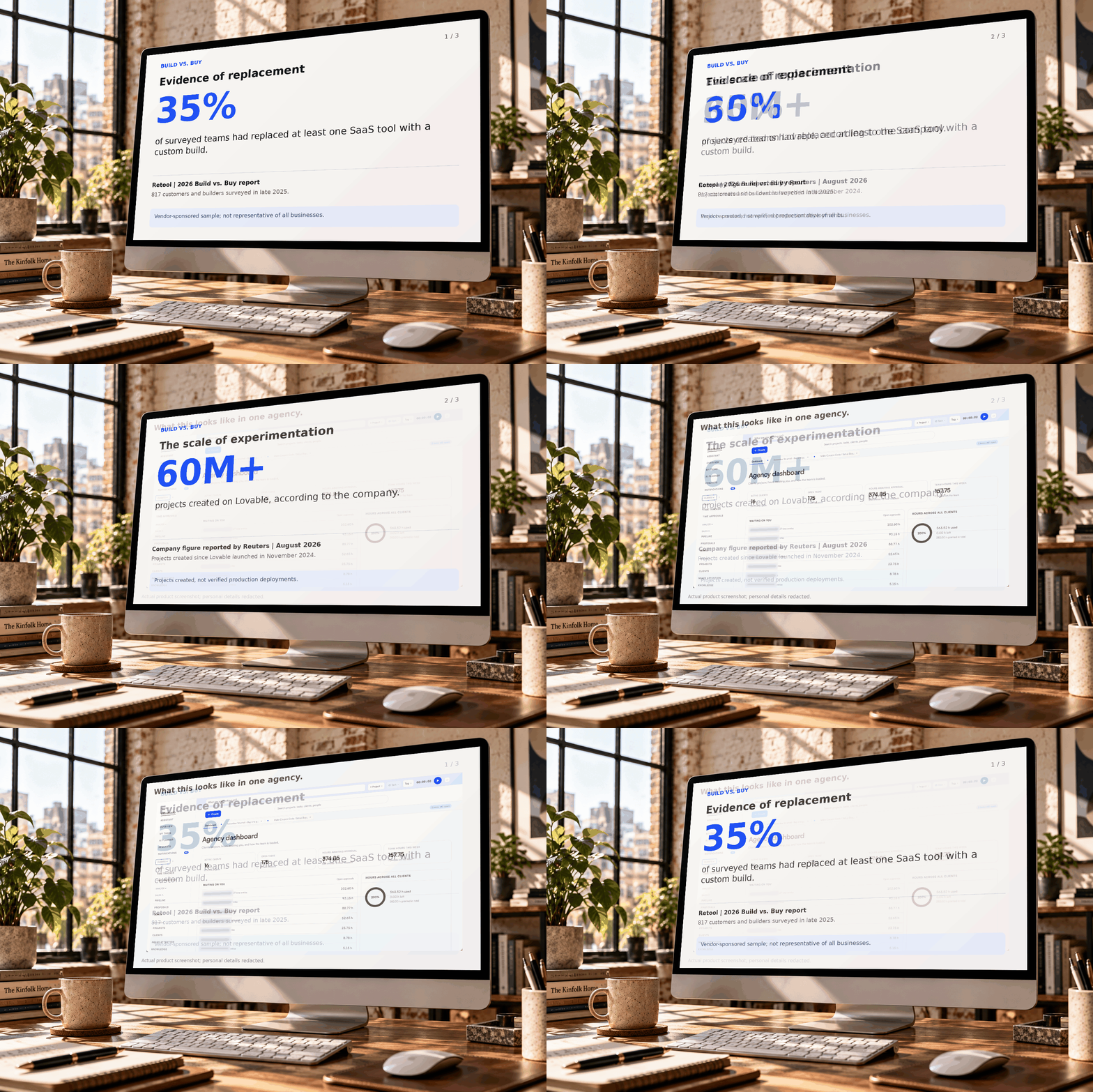
Retool’s 2026 Build vs. Buy report surveyed 817 customers and builders in late 2025. It found that 35% of teams had replaced at least one SaaS tool with a custom build. Because this is vendor-sponsored research among builders, it reflects early adopters more than the broader business landscape.
In August 2026, Reuters reported that Lovable said users had created more than 60 million projects since its launch. That number measures experimentation and says little about successful production deployments. The scale still helps explain why building now comes up in conversations once dominated by buying.
My experience is one example, and other businesses may not see the same savings. It is still a reason to rethink who can build and what custom software costs.
Moving faster still comes with responsibility
A small agency can test a bounded workflow with a few people. A large company may have legacy integrations, procurement requirements, training needs, and competing departmental priorities. Switching costs can outweigh subscription savings, even when building gets cheaper.
Some hesitation comes from unfamiliarity. Some reflects real operational risk. I expect smaller businesses with clear workflows to move first, while larger organizations may build around existing systems before replacing them.
Enterprise-tier features do not equal enterprise readiness. A useful interface says nothing about security, reliability, or compliance.
In May 2026, WIRED reported that researchers had found more than 5,000 AI-built web apps with little or no access protection. Vendors disputed parts of the findings and pointed to configuration choices. The lesson I take is to treat deployment with the same care as the build.
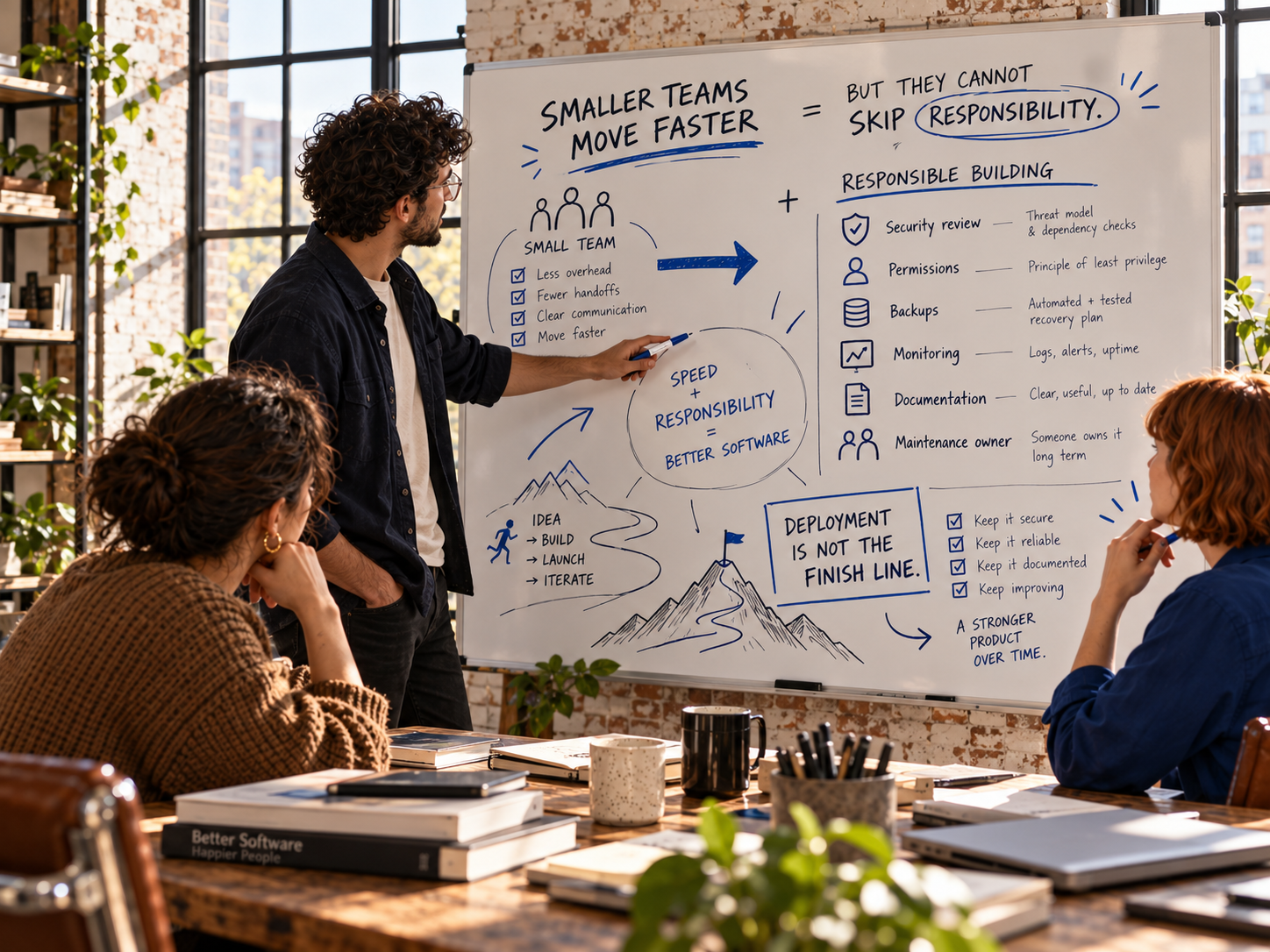
Lovable’s own guidance says automated checks do not replace a thorough security review. Before relying on a custom system, I would require tested permissions, protected credentials, restorable backups, monitoring, documentation, and a named maintenance owner. Sensitive or critical workflows need review from experienced AI developers and security specialists.
The economics must include ongoing operation and support. Replacing five subscriptions still leaves us dependent on infrastructure providers. Two months of building also cannot show what years of maintenance will cost.
The opportunity is to design how a business works
I see a larger opportunity than another fixed application: systems that help companies build, customize, and govern tools around their own needs. The companies providing those systems will still be software companies. What changes is what customers buy.
For product designers and agencies, the opportunity is to translate business knowledge into usable products. Understand the workflow, define the relationships, make decisions visible, and leave something others can maintain. Generating screens is only one part of that work.
Start with one process worth improving. Define success, prototype with non-sensitive data, test with actual users, and plan a controlled transition. Keep the tools that still earn their place.
I expect SaaS to stay. I also expect every subscription to justify why buying it beats building the part we need.
The saving gets attention. The ability to design how our business works is what makes the change matter.
Find more Community stories on our blog Courtside. Have a suggestion? Contact stories@dribbble.com.