About the Author:
Vicente Reyes Montealegre heads Afternow’s Brand and Web teams, guiding SaaS companies, enterprises, and fast-growing startups through their digital journeys. The agency’s work spans strategy, brand, website, product and development, all under one roof and connected to one vision.
If you are an in-house designer or work at an agency, you have probably heard it from leadership: “We need to be more strategic.” They usually say it with conviction and rarely explain it. That makes it feel important and hard to act on, especially when nobody shows you what it looks like.
You might read it as a request to become a brand strategist or a product strategist. Much of what follows overlaps with those roles, but this piece is about strategic thinking for designers at any level.
Strategic thinking sits close to the root of design itself. To design is to plan, to project, to give something intention and purpose. That intention only holds up when it is grounded in the context the work has to live in. In my experience, building a strategic mindset into your daily work is one of the clearest signs you are ready for your next career move.
What it looks like when strategic thinking is missing
When the comment comes, it usually points to one of three things.
- Not knowing how the business works. Whether it’s your employer or a client, the gaps show up in comments and meetings. A designer may not know how the company makes money, who buys and uses the product, or what it needs to stay ahead.
- Working in a silo. The design role becomes a list of tasks, disconnected from the people around it. A brand designer lays out the sales deck without asking what the sales team needs it to do. A product designer polishes a flow without knowing what the feature is meant to move. At team level, designers end up working for designers, producing good work that rarely connects to the rest of the operation.
- Talking about design only in design terms. The work might be strong, but the case for it is made in craft language. Leadership hears grids, type, and consistency, but listens for growth, efficiency, and risk. The value gets lost in translation.
What strategic thinking looks like in practice
Leaving jargon aside, being strategic is a way of thinking. It shows in the questions you ask, how you weigh trade-offs and how you get from evidence to a conclusion. It also shows in how you define success beyond the immediate ask, and how you decide when things are uncertain.
Much of it is visible in how you show up in a room. Arrive with uncertainty, complaints, or opinions, and you hand the problem to someone else. Arrive with curiosity, clarity, or a recommendation, and you take ownership. When you explain how you landed there, including your assumptions and trade-offs, you give the room your reasoning. Even if your call turns out to be wrong, people have something concrete to build on.
That holds at any level, from team lead to a first senior role. Here are three habits and three questions that help.
1. Know where the business is going
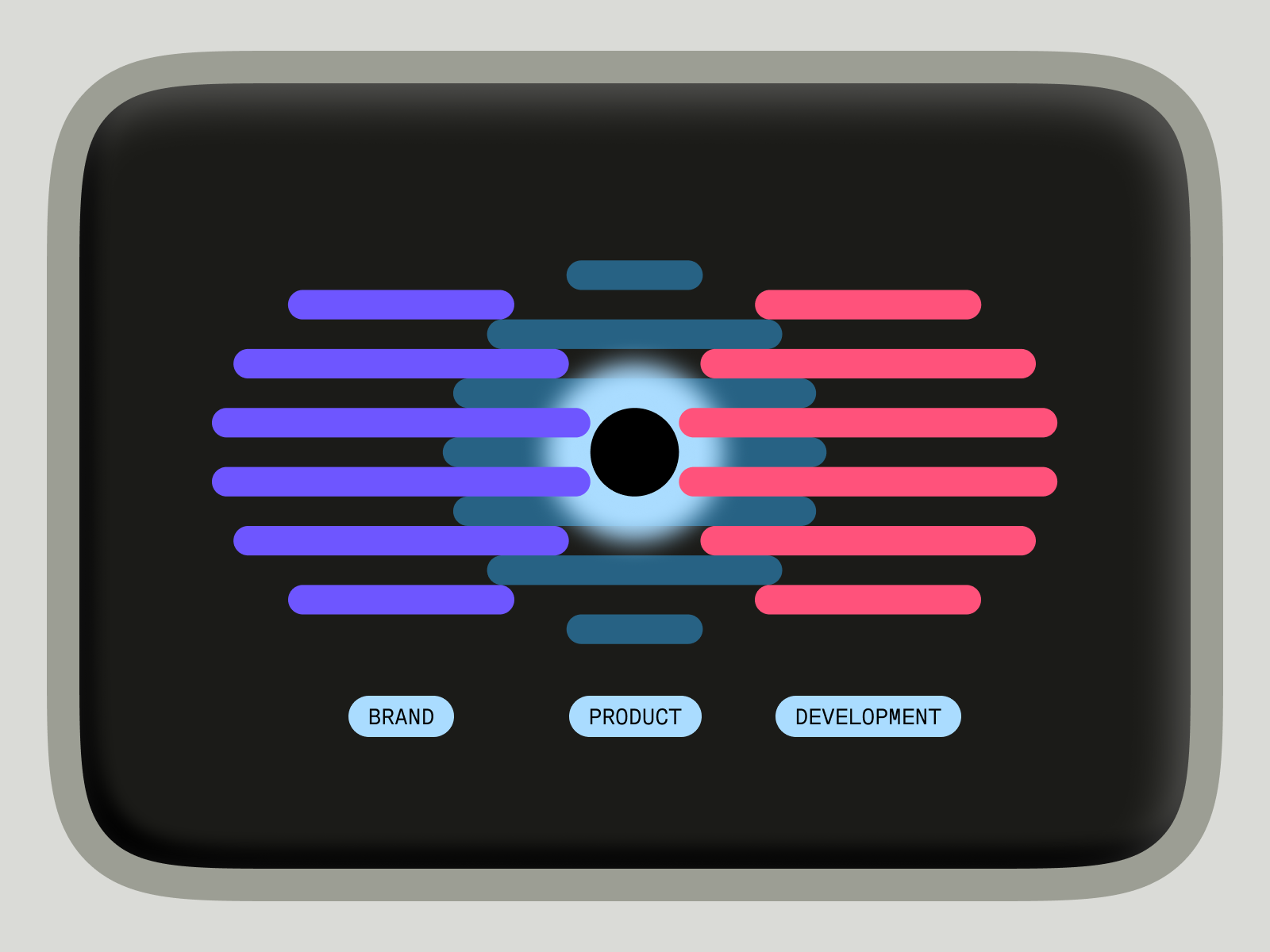
Whatever company or client you work with, a basic understanding of the business and its industry should inform your approach. What value does the company bring? How does it make money? Which customers does it want next?
Most designers get a version of this in a discovery session, a roadmap, or a leadership update. Many skim past it as someone else’s job. It is yours too. Design is one of the main ways a company’s direction becomes visible, on its website, in a pitch deck, across marketing channels, and in the product itself.
Once you know where the business is heading, you can ask the strategic question: how is my work helping us get there?
2. Look beyond your design team
You probably work alongside project managers, developers, marketers, sales, and HR, and sooner or later their requests land on your desk.
Learning how those teams operate, and how your work supports theirs, changes how they see you. Design can improve how a company works internally. Think of smoother design system handovers to development, more usable marketing assets, or internal initiatives that build culture. Each of these small wins shows other teams the value of design first-hand.
Once you understand how other teams work, you can ask the strategic question: how can we improve how we work together?
3. Connect your work to what leadership values
Presenting work gets harder when the audience is unfamiliar with design or sits in senior leadership.
The same principle applies here: design for your audience. With a client or senior leader, start by understanding what they value. Lead with the bottom line, keep it high-level, and bring solutions. Show what your design affects and how it supports company goals, so people can decide quickly.
Working on a better-looking website? Explain how a better structure can bring in more leads. Building a new design system? Explain how much time it saves as the product scales.
Once you know what your audience values, you can ask the strategic question: why should my work matter to them?
How we built strategic thinking into Afternow
Leadership asked our whole company to be more strategic, too.
We have made most of the mistakes in this article. We gave our team too little visibility of the business and financial decisions behind the agency, which left people disconnected from the market. We worked in silos, handing tasks between teams without guardrails or a shared sense of direction. And we bored more than one client with design jargon, focusing on how things looked over the value we brought.
We are in a very different place than five years ago, with plenty of room left to improve. Today we treat strategy as a service and as a mindset across every team, from design and development to sales and HR. These are some of the initiatives our designers have worked on over the past year.
- Defining our own brand. As part of becoming Afternow, we brought our team leads together to pin down who we are. We defined the value we bring, what makes us different, the services we provide, what we can prove, and where we want to be in a few years.
- Sharing how we use AI. Designers used to explore AI alone. Now we evaluate tools together and decide what belongs in our processes.
- Smoother handovers. From UX wireframes to branding, web and product design, and on to development, we build design systems, modules, and templates that move between teams with less friction. Less time on translation, more on execution.
- Everyone at the table from day one. On client projects, strategists, designers, and developers join from the start. We weigh every decision or pivot against the work that follows.
- Rethinking how we present. We keep adjusting our presentations to what matters to the client. What we once called “playful” or “creative,” we now frame as “impactful.” “Serious and understated” has become “scalable” or “manageable,” language that matches what marketing managers care about.
None of these initiatives rely on one person. Each connects to what the business needs: our value, our workflows, and our alignment with clients.
Where craft fits into strategic design
Many of us came to design for the details: the craft, the concept, how a single typographic choice or color can carry a story. Some well-established designers have stayed far from corporate dynamics and built remarkable careers, with work that reaches people in ways no spreadsheet could back up.
Nothing here asks you to give that up. The care behind a typeface or a micro-interaction is already a series of decisions about intention and purpose, which is what strategic thinking is. Grounding that intention in the business, the teams around you, and your impact gives the care direction. It also earns the craft the time and trust it needs. Often, the most persuasive strategic argument in the room is the work itself, made well.
Widening the brief
In the early 2000s, design thinking carried the designer’s process into boardrooms and business schools. UX and product design brought designers closer to how companies build and grow. Today, more product designers are founding companies, and generative AI is raising real questions about our role.
Strategic thinking has been the constant through every shift. Each time, designers had to adapt to new actors, trends and industries, and decide what design should take responsibility for next. As someone in daily contact with culture, businesses and people, you are well placed to do the same.
If you are still unsure what “be more strategic” means where you work, ask. If the answer is clear, you have your brief. If it isn’t, helping define it might be the most strategic place to start.
Find more Community stories on our blog Courtside. Have a suggestion? Contact stories@dribbble.com.