


About the Author:
Zlatina Petrova has spent 13 years shaping brands and digital products across Silicon Valley and Europe. As Founder and Design Director of Brandly, she works with tech startups, VCs, global brands and government institutions including work on Bulgaria’s national design system. Her work sits between branding, product design and UX/UI, with a belief that design should do more than look good: it should help businesses grow, products work better and brands mean something to people.
When Brandly started, clients weren’t buying the company. They were buying the people behind it. I already had a solid reputation of my own: I had led product design at an LA-based startup, worked as a creative director in Florida, and won one of Europe’s most prestigious design awards.
The media were dying to interview me. Nobody was dying to interview Brandly. Same with the clients. They trusted me first, and the company second. Trust lived in the founder before it lived in the brand. This is the core of effective executive personal branding. Only later did Brandly accumulate enough history, language, and systems to carry that trust independently.
In that transition, one truth became obvious: people don’t experience companies first. They experience people.
In the early stages, a founder’s personal brand is not a vanity project sitting next to the company brand. In a founder-led business, it is often the first interface through which people decide whether your company deserves attention at all.
Before they understand your product or mission statement, they are asking much simpler questions:
- Do I trust this person?
- Do I believe what they believe?
- Do I want to listen to them?
- Do I want to work with them?
The personal brand becomes so closely attached to the company that the founder eventually becomes the bottleneck for trust. If they step away, clients become nervous. If they move on to something new, the company suddenly feels different. If they want to sell the business, part of its value is still sitting inside one person’s relationships, reputation and way of thinking.
The founder’s real job goes far beyond visibility. The job is to turn personal conviction into something the company can eventually carry without you. Here is how the founder shapes the brand around them, and how that personal equity eventually becomes company equity.
Establishing Brand Identity and The Founder’s Role In Corporate Branding
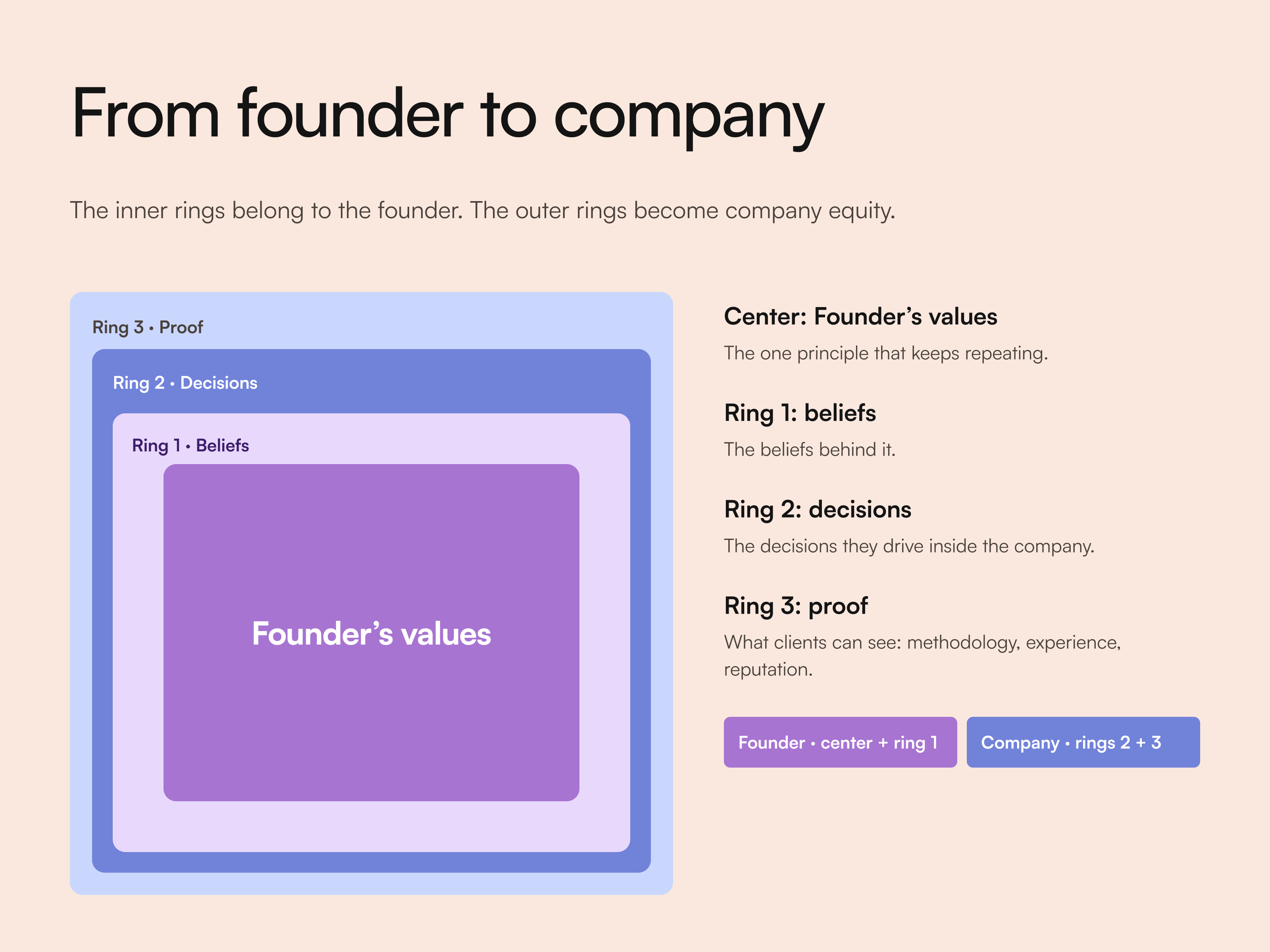
Inevitable brands rarely begin as systems. They begin as conviction. Before there are guidelines, culture decks, and campaigns, there is usually one person who sees something that does not yet fully exist.
That person has to believe in it long enough for everybody else to catch up.
This is what I mean by devotion. Not founder mythology, and definitely not “hustle culture.” I mean feeling the brand deeply enough to sense when something strengthens it and when something quietly weakens it.
In the beginning, you notice the wrong tone in a sentence, the product that makes money but weakens positioning, or the impressive partnership that simply does not belong in the world you are building. Over time, your instinct teaches the rest of the organization what the brand actually is.
When the founder cares deeply about the details, employees start making better decisions without constant approval. What started as one person’s conviction slowly becomes something shared.
If the founder carries the brand internally, the personal brand makes that worldview visible externally. But this is where many founders get personal branding wrong.
Your personal brand is not a diary of everything you think, eat, or do. It is the clearest public expression of the parts of you that give the company meaning: your judgment, beliefs, standards, taste, expertise and way of seeing the world.
The public version of you should still be true. Just edited. You do not need to publish every private detail to feel human; you just need to make the part of you that explains the company legible to others.
Takeaway: The founder shapes the brand from the inside first. Personal branding makes that worldview visible from the outside.
Core Value Alignment and Strategic Brand Development for B2B Founders

There is a strange ritual happening in branding workshops everywhere, including plenty of B2B brand strategy consulting sessions we’ve run ourselves. Someone opens a Miro board. Everyone gets virtual sticky notes. Forty-five minutes later, almost every company on Earth discovers its values are innovation, integrity, excellence and customer-centricity.
If your competitors can copy your values without changing a word, they are not your values.
Real values are inconvenient. They come from your experience: the managers you never wanted to become, the moments that made you proud, the clients you instinctively protect, and the compromises you refuse even when money is on the table.
This is where founder branding begins. Not with “What should I post about?” but with “What do I believe so strongly that it repeatedly changes my decisions?”
Founders encode their values into the company whether they intend to or not. Those values dictate:
- Who gets hired
- How fast the product ships
- Whether difficult conversations are had
- What the company quietly tolerates
Repeated decisions become culture. Culture becomes user experience. Experience becomes reputation. Reputation becomes a brand.
Try building a founder value map. Take five important moments from your professional life, especially the frustrations and failures. Ask: What did this teach me that I now believe very strongly?
Look for repetition. You may discover that five apparently unrelated stories express the same principle. “Care” is not a value until it changes how you price projects or communicate bad news. A brand becomes credible when values create visible trade-offs.
Takeaway: Your founder brand should be built from beliefs with consequences, not values that simply look good on a wall.
Thought Leadership Strategy and Elevating Your Executive Personal Brand

Founders often tell me they “should be posting more.” I’m not convinced.
The internet does not urgently need another founder sharing seven lessons from waking up at 5 AM. What people need from experts is not more content. They need judgment.
A strong founder brand gives people a sense of how you think, what you challenge, and what matters to you before they ever buy.
A brand identity designer can post: “Five branding trends for 2026.” Or they can say: “Most early-stage companies redesign their visual identity too early, because the real problem is they haven’t decided what they want to be remembered for.”
The first gives me information. The second gives me perspective. Perspective is invaluable in businesses where clients buy trust: consulting, law, venture, architecture, or complex B2B software. A case study tells me what you did; a point of view tells me how you’ll think when we hit a problem neither of us has seen before.
A true thought leadership strategy begins with three questions:
- What do I believe?
- What observation made me believe it?
- What do I do differently because of it?
A belief that never changes your behavior is just positioning copy. For example, we believe brand consistency shouldn’t depend on designers policing assets. So, what do we do differently? We treat governance and contribution rules as part of the design itself, not an afterthought.
Now, you aren’t just claiming expertise; you are showing how it changes your work.
Takeaway: Don’t use your personal brand to prove that you are visible. Use it to make your thinking visible.
Brand Cultivation and Hiring for Corporate Brand Alignment
Who is helping you build this thing?
Customers experience your brand through a salesperson, support agent, designer, freelancer, and sometimes a vendor. Every one of them translates the brand through hundreds of micro-decisions. A brilliant person who repeatedly makes choices that feel wrong for the company can weaken the brand more than an average logo ever will.
The best teams develop a shared instinct. They know which compromise the company will make and which it won’t. They know when something is technically correct but still not right.
You can call this cultural fit or brand alignment. The outcome is what matters: the person amplifies the signal rather than introducing static.
This must influence hiring. Assess skill, but also ask questions that reveal taste and judgment:
- Show candidates real scenarios.
- Ask what they would protect when time runs out.
- Ask what they refuse to compromise on.
Look at your existing team with the same honesty. Who strengthens the brand? Who is excellent at their job but consistently pulls the company toward a different identity? Alignment cannot be ignored forever.
Takeaway: Skills determine whether someone can do the job. Alignment determines whether they strengthen the brand while doing it.

Enterprise Brand Architecture: Scaling from Founder to Corporate Entity
As the brand grows, the founder’s role changes. Early on, trust travels through the person. Clients use your reputation as a shortcut to decide if the business is credible. But growth demands a new question: where should that trust travel next?
This brand equity transfer is crucial. Brand architecture dictates how much of the founder’s reputation transfers to the company, how much remains with the founder, and which new offers borrow from either.
Founders are tempted to capitalize on momentum. If people trust you, it’s tempting to endorse every new service or product you launch. Sometimes that is smart. Sometimes it is simply logo slapping. Accumulated trust should only travel where the promise and experience justify it.
Navigating this is why companies hire a specialized brand architecture agency, but you can start with three core paths:
- The Unified Brand: If a new offer delivers the same core promise and experience, it belongs inside a unified brand. The goal is to move trust away from the founder and deeper into the company.
- The Endorsed Brand (Brand Extension): If the experience belongs to the same world but the promise is different, it’s a brand extension. A visible association (“From the founder of…”) reduces perceived risk without pretending the new venture is just another version of the parent company.
- The Individual Brand: If the new offer has a completely different promise and audience, forcing the founder’s name onto it creates confusion. Founder equity shouldn’t be permission to attach the same reputation to everything.
The strategic goal is to make the founder an endorsement layer, not a permanent dependency.
Early on, use your personal brand. Let your name open doors and reduce risk. But simultaneously, the company must accumulate its own evidence: recognizable methodologies, systems, and a consistent experience.
The founder says, “This is what I believe.” The company proves, “This is how we operate.” Eventually, the customer concludes, “I trust this organization, even when the founder is not in the room.”
Many founder-led companies fail to reach this point, and Brandly was no exception early on. If the founder remains the ultimate source of reassurance, it becomes a massive problem the moment they want to step back, launch something new, or sell.
The best transition is gradual:
- Give visibility to your team.
- Turn personal know-how into company methodology.
- Move recurring ideas from your LinkedIn posts into the company’s language.
- Let clients form relationships beyond you.
Make the experience consistent enough that your personal reputation becomes the introduction, not the entire argument.
In maturity, the founder brand and company brand stop competing for attention and start endorsing each other.
Takeaway: In the beginning, the founder lends trust to the company. During growth, convert that borrowed trust into company equity. Use brand architecture to decide where that trust should compound, endorse, or stop.
People may buy the founder before they buy the company. That is not a weakness to hide; it is an advantage to design deliberately. But the founder’s real job is to build a world compelling enough that, eventually, people no longer need them standing at the entrance.
Find more Community stories on our blog Courtside. Have a suggestion? Contact stories@dribbble.com.


