


Most companies want sustainable growth. Then they divide the work responsible for creating it into competing departments, budgets and agencies.
Brand marketing teams build awareness. Performance marketing teams generate leads and sales. Creative teams receive briefs from both. Website and retention teams inherit promises they may not have helped shape.
Each team can do good work while working from a different version of the truth.
In our Brand-Backed Performance™ framework, these responsibilities connect: brand creates a credible reason to choose, marketing creates opportunities to be chosen, and customer experience proves the promise. Performance tells the system what to improve.
Why the brand vs. performance marketing divide fails
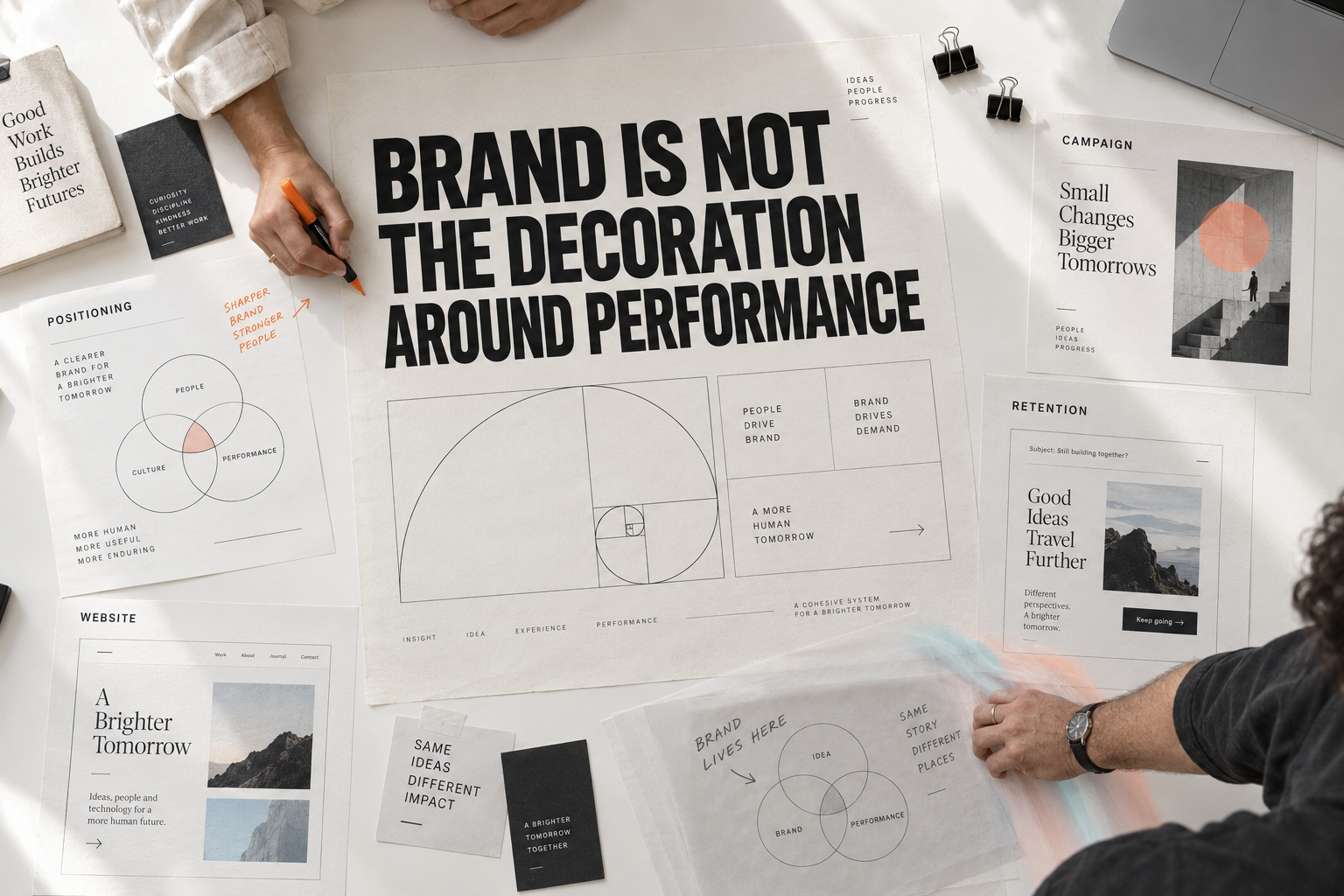
Customers do not experience brand and performance as separate disciplines. They see an ad, visit a website, compare the offer, read reviews and use the product. Every interaction reinforces an expectation or introduces doubt.
Inside the company, these moments belong to different departments. Outside it, they form one continuous judgment.
Les Binet and Peter Field’s research for the Institute of Practitioners in Advertising, published as The Long and the Short of It, distinguishes short-term activation from long-term brand building and warns against relying on short-term online metrics as the primary measure of success.
These activities produce different effects over different periods. Managing them together means recognizing those differences while connecting their contribution to growth.
Brand gives performance something worth amplifying

When growth slows, companies often finalize the offer, media plan and landing page before asking creative teams to make everything compelling. That assumes there is already a strong reason for customers to care.
If positioning is interchangeable, creative must manufacture novelty. If the value proposition is unclear, the website compensates with more copy. If the product is difficult to distinguish, the offer becomes a discount.
These weaknesses can surface as creative fatigue, low conversion, unqualified leads or poor retention. Sometimes several teams are describing the same problem: customers lack a clear, differentiated and credible reason to choose.
Brand strategy establishes that reason and gives the growth plan something meaningful to amplify.
Performance extends beyond the ad platform
Performance marketing includes media buying, testing and attribution, but its results depend on what happens before and after the click.
An audience may already recognize the brand or encounter it for the first time. The creative may communicate immediate relevance or require explanation. After the click, the landing page either continues the promise or creates friction.
Google’s Modern Brand Measurement playbook explains how lower-funnel models can undervalue brand media when they measure only its direct contribution to sales. It advocates connecting brand indicators with commercial outcomes and combining longer-term and lower-funnel measurement.
Measuring only what happens closest to a transaction can confuse proximity with causation.
Quick Tip: How to measure brand and performance together
Combine awareness, recognition, consideration, branded search and direct traffic with conversion, acquisition cost, revenue, margin, retention and lifetime value. Assess immediate response alongside longer-term change, without assigning every outcome to the final measurable touchpoint.
The cost of disconnected handoffs

A brand marketing agency develops positioning. A performance marketing agency turns it into ads. A website partner builds landing pages. An internal team adapts the message for email. Each interpretation can subtly change the story.
I call this the handoff tax: the loss of clarity, distinctiveness and accumulated learning when work moves between disconnected teams.
An ad promotes an offer the homepage barely explains. A landing page converts but builds no recognition. A successful message stays inside the ad account instead of informing sales materials or brand strategy.
The issue is the absence of a shared strategy and a reliable way to carry learning across teams.
Quick tip: How to divide your budget between brand and performance
There is no universal ratio. The frequently cited 60/40 split is a research-based starting point, not a rule for every business. Category maturity, buying cycles, existing demand, margins, growth stage and brand strength influence the appropriate balance.
How brand and performance marketing work together
Start with shared positioning, customer insight and proof. Apply them across creative, media, the website, sales and retention. Feed winning messages, customer objections and conversion insights back into strategy and experience decisions.
1. Brand creates the reason to choose
Define what the company can credibly stand for, what customers value and where meaningful competitive differences exist. Use that foundation to guide positioning, messaging, identity and experience.
The goal is a promise the organization can repeatedly prove.
2. Marketing creates opportunities to be chosen
Creative, content, paid media, search, partnerships and social distribution bring that promise into the market.
Audiences and formats need different expressions. The underlying reason to choose should remain recognizable, whether someone encounters a short ad or a detailed product page.
3. Experience proves the promise
The website, product, sales process, service and customer support turn claims into evidence.
If marketing promises simplicity but purchasing is confusing, the experience undermines the message. If the company claims premium service, its interactions must support that claim.
4. Performance makes the system smarter
Creative testing can reveal persuasive proof points. Search behaviour shows how customers describe their needs. Conversion research exposes confusion. Sales conversations uncover objections. Retention data shows where customers receive lasting value.
These insights should inform brand and experience decisions as well as the next campaign. Shared learning makes integration an ongoing practice.
DrTung’s shows the value of a connected system

In our work with DrTung’s, a heritage oral-care company, more than 25 years of product credibility sat behind an eCommerce messaging focused on generic natural oral-care claims.
Research identified a stronger position: clinically proven natural products and dentist-trusted solutions. That idea shaped the Shopify experience, paid media, email, social content and B2B journey.
As reported in our DrTung’s brand and eCommerce case study, revenue reached 2.3 times its prior-year level and total orders increased 99% year over year.
Those results cannot be attributed to one campaign or isolated design decision. The practical lesson is that a clearer promise, carried through acquisition, conversion and retention, gave each discipline a stronger foundation.
What this means for designers
Brand designers help determine how quickly a message is understood, how easily a brand is recognized and whether an experience feels credible.
Distinctive assets support recognition across repeated exposures. Information hierarchy helps people understand an offer. Continuity between an ad and its landing page reinforces trust. Usable interfaces reduce friction.
Some benefits accumulate over time; others appear in immediate customer behaviour. Assessing both requires questions broader than whether design caused an individual sale:
- Do customers understand the offer more clearly?
- Can they find the evidence needed to decide?
- Does the landing page deliver on the ad’s promise?
- Does the design system improve recognition and make future campaigns easier to produce?
These questions connect creative decisions to observable outcomes without reducing every contribution to last-click attribution.
Give teams a shared commercial objective

Budget labels and departmental ownership are useful for administration. They become limiting when teams optimize individual channels without considering the whole customer experience.
Leaders should ask whether investments reinforce the same reason to choose. Can performance teams explain the positioning? Can brand teams access customer-response data? Does retention learning influence acquisition?
Shared answers help teams interpret results, resolve conflicting priorities and carry useful insights into the next decision.
They were never opposing disciplines. We built organizations that taught them to behave that way.
Find more Community stories on our blog Courtside. Have a suggestion? Contact stories@dribbble.com.


