About the Author:
Zlatina Petrova has spent 13 years shaping brands and digital products across Silicon Valley and Europe. As Founder and Design Director of Brandly, she works with tech startups, VCs, global brands and government institutions including work on Bulgaria’s national design system. Her work sits between branding, product design and UX/UI, with a belief that design should do more than look good: it should help businesses grow, products work better and brands mean something to people.
A few years ago, Forbes profiled Brandly. We started as a handful of home-based freelancer designers; now, we’re building B2B brand strategy at a national level for companies from Series A onward. The editor asked me whether I’d known Brandly would become what it is today. I said, “Yes. It was inevitable.” But it didn’t always feel that way.
An inevitable brand represents an idea whose time has come and spreads like wildfire. And the thing about inevitable brands is that they seem obvious in retrospect.
There was a time when we were just five people working from home, hunched over our computers. We were trying and trying to create Brandly. But at some point, after so many experiments, the brand took on a life of its own.
Just like great art, great brands come alive and begin to tell their creators how to bring them into existence. Michelangelo saw David in a five-meter block of marble. He didn’t create David; he set him free. David was already there.
A great brand works the same way: it is discovered, revealed, and not simply created.
But to discover it, we have to see past the beliefs and behaviors that get in the way. It’s a little like parenting: we don’t try to control our children and tell them exactly which career path to choose. We help them discover who they are.
Brands need the same space to reveal themselves.
Over the past seven years, building brands across industries and countries, we’ve learned that creating an inevitable brand often means stepping back before adding more.
Here are five ways to build an inevitable brand.
1. Uncover your corporate identity and brand truth
Asking your customers who your brand should be is like asking strangers who you should become. Your brand’s truth doesn’t come from there. And it doesn’t come from an agency either. Going to an agency and asking them who you should be is like going to a therapist and asking them to present three different versions of the person you could become.
A good therapist guides you through the process of discovering the answer on your own. A good branding partner should do the same. Your brand’s truth and essence come from within: the founder’s vision, the reason the company exists, and the change it wants to create.
The job of corporate identity development is to uncover that truth, articulate it, and make it recognizable to your audience.
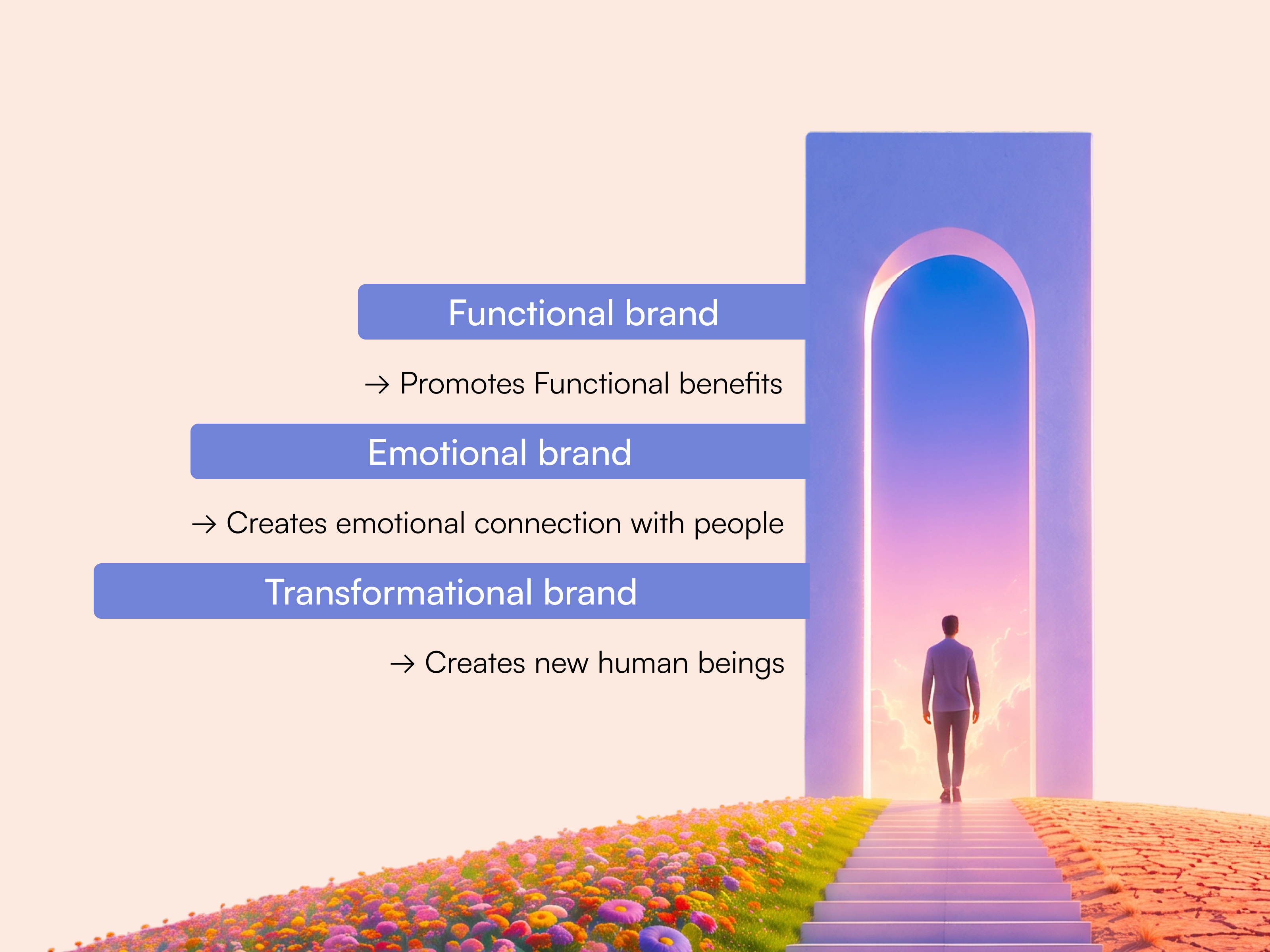
Level 1: Functional brands
This is where most brands live (and die). They compete on functional benefits, usually marginal differences such as “faster,” “cheaper,” “better,” or “a one-stop shop.” The problem is that there is so much competition at this level that brands experience constant downward pressure. If your primary advantage is being cheaper or faster, someone else can eventually become cheaper or faster than you.
Level 2: Experiential brands
Experiential brands still deliver functional benefits, but they add another layer: the experience of using the product or the service.
On a functional level, Ryanair sells you a plane ticket. It gets you from point A to point B. But have you ever been on a Ryanair flight? Let’s be honest, the experience isn’t the main reason you bought the ticket in the first place.
On the other hand, Virgin takes a different approach. You watch a movie, enjoy the service, and experience the personality of the brand throughout the journey. That is the difference between functional and experiential branding.
Level 3: Transformational brands
This is where iconic brands live. Transformational brands don’t just sell products or experiences. They create new human beings.
Before Nike, people jogged on the street. Nike helped make it aspirational to become a “weekend warrior.” This is someone who sees themselves as an athlete even if they aren’t a professional one.
Before Apple, if you showed up to work wearing a hoodie or a t-shirt you’d get fired. Apple created that generation of entrepreneurs, the disrupters.
Pro tip: Discover which level your brand belongs to.
We think about branding across three levels. Understanding which one fits your vision can help you see what kind of brand you are actually building.

2. Build memory through emotional brand positioning, not just visual identity
This is probably one of the most challenging ideas for founders. If you want to build an inevitable brand, you need to understand that becoming unforgettable starts with becoming memorable. And memory can be built in two ways: repetition and emotion.
Repetition is the traditional way of building memory. You repeat a message over and over until your audience starts repeating it too. The problem is that repetition is expensive.
A more powerful and most cost-efficient way of doing this is to create emotion. Emotion creates memory on a deeper level.
Memory attached to emotion is a survival mechanism. It’s the same reason you never forget the food that made you sick.
Brands can use the same principle: the extent to which you can consistently evoke that emotion is the extent to which your brand will be remembered.
We call this brand frequency, a crucial element of emotional brand positioning.

How do you discover your brand frequency?
Start by identifying the peak experience of your brand, which is the emotional high point of the product experience.
When developing a B2B brand strategy for Nexa, a client of ours that is revolutionizing the workforce by introducing robots and AI agents into everyday business processes, the peak experience is the moment a founder opens their phone and sees that the work has been done without micromanaging anyone or even being at the office. The emotion is freedom and relief.
Now take an iconic brand like Airbnb. The peak experience is the moment you’re invited to sit at your host’s table, break bread, and share a meal. You may be in a foreign country, but somehow, you feel like you belong.
That is the art of branding: delivering the emotion before the customer even experiences the product.
Takeaway: The majority of communication between humans is non-verbal. That’s why what your brand emotes is more important than what your brand says to its audience.
3. Define your brand promise and positioning
Another important step in building an inevitable brand is identifying your brand promise. It’s what you solve for your customer at a functional level better than anyone else.
This is what your brand says. Your brand frequency is what it emotes.
Brand promises are usually simple: “faster,” “simpler,” “cheaper,” and “easier.” But there is an important difference between a brand promise and a slogan.
A brand promise describes what the brand does. A slogan emotes what the brand does.
Think about slogans as pieces of poetry. They inspire, they emote, and they are the outcome of your brand’s frequency.
This is why blindly asking AI to give you 20 slogans becomes irrelevant. AI can be an excellent assistant in the brainstorming process. It can challenge directions, generate variations, organize thinking, and help you explore language faster.
But it should not be in charge of your decision as a brand leader. If the underlying emotion isn’t clear, generating another 100 slogans won’t reveal it. Human work comes first: discovering the truth. AI can then help you articulate it.

For Nexa, the brand promise is to simplify business operations by solving workforce limitations.
The slogan we created for them is: Beyond human scale.
It carries the idea that technology isn’t separate from people. It is an extension of human capability that allows us to operate beyond our natural limitations. And the beautiful part about it? It also sounds great in other languages.
Takeaway: Brand promise is cognitive. Slogan is emotional.

4. Develop a cohesive visual identity system
Once you understand the core elements of your brand universe, it’s time to translate them into a consistent visual identity system.
This is where many brands lose their way. They rediscover a new version of themselves with every presentation, campaign, landing page, social post, and product release.
But an inevitable brand should feel consistent everywhere. To help our clients find their way, we use a simple, yet effective technique called “the brand map.” The matrix helps us understand consumer perception by showing where a brand sits across two dimensions: price perception and identity. This becomes a blueprint for the brand’s visual language because design delivers emotion before a customer ever buys the product.
Once you know where your brand sits, decisions about typography, color, imagery, composition, and art direction become less subjective. Instead of asking, “Do we like this font?” you can ask, “Does this font communicate the perception we have chosen?”
The matrix has two axes: Affordable-Expensive and Traditional-Modern.
Expensive + Traditional
Serif typography, deep and muted color palettes, and moody photography that highlights craftsmanship, heritage, and texture.
Expensive + Modern
An ultra-minimalist, futuristic aesthetic. A lot of white space, clean geometric sans-serif fonts, highly restricted color palettes, often monochromatic with sharp metallic accents and abstract or conceptual imagery.
Affordable + Traditional
A familiar, warm, and inviting visual language. Friendly fonts, approachable earthy or primary tones, and authentic, human-centric photography focused on everyday people and real-life moments.
Affordable + Modern
A high-energy, vibrant, digital-first visual language. Bold layouts, bright color accents, high contrast, clean neo-grotesque typography, and dynamic imagery designed for a screen-first generation.
5. How to hire a branding agency and direct your team
You know the saying: “If you want something done right, do it yourself.”
Brand building is one of the places where we would challenge that idea.
You shouldn’t design every asset yourself. But you also shouldn’t completely outsource the responsibility for your brand either. You need to play many roles and take each of them seriously.
Hire
When looking to hire a branding agency or freelance designer, look for a branding partner who is great at creating a mood. They understand how visual decisions affect the nervous system of the viewer and can translate your emotional brand positioning into typography, color, imagery, composition, and movement.
One way to test this when evaluating outsourced brand design is to ask the designer to create a mood board based on your brand emotion. Then show it to several people. Don’t ask them, “Do you like it?” Ask them: “How does this make you feel?” If the mood board consistently evokes your brand emotion, you may have found the right design partner.
Direct
Once you find the right partner, your second role as a brand leader is to direct.
Ask the designer to deconstruct, distill, complement, and document each part of the visual system:
- Colors
- Typography
- Logo
- Iconography
- Photography
- Motion
- Layout principles
These elements form the foundation of your style guide. We also strongly recommend adding real brand applications and mockups across every customer touchpoint: website, social media, video, graphic design, UX, UI, presentations, sales materials, and anything else your team uses regularly.
Identify which assets are most critical and build those first.
Evangelize
The final role is often forgotten. A style guide sitting in a folder doesn’t create consistency. People do. Once the system exists, someone has to protect it, explain it, teach it, and make sure the team understands not only what the rules are, but why they exist.
That is what turns a visual identity into a living brand. And it brings us back to where we started. An inevitable brand is not something you manufacture in Figma. You discover its truth. You identify the emotion behind it. You articulate its promise. You translate it into a recognizable system. And then you protect that system without suffocating it.
The goal of any successful B2B brand strategy isn’t to control every expression of the brand. It is to understand the brand deeply enough to let it reveal itself. And eventually, the right decisions start to feel obvious. Almost inevitable.
Find more Community stories on our blog Courtside. Have a suggestion? Contact stories@dribbble.com.