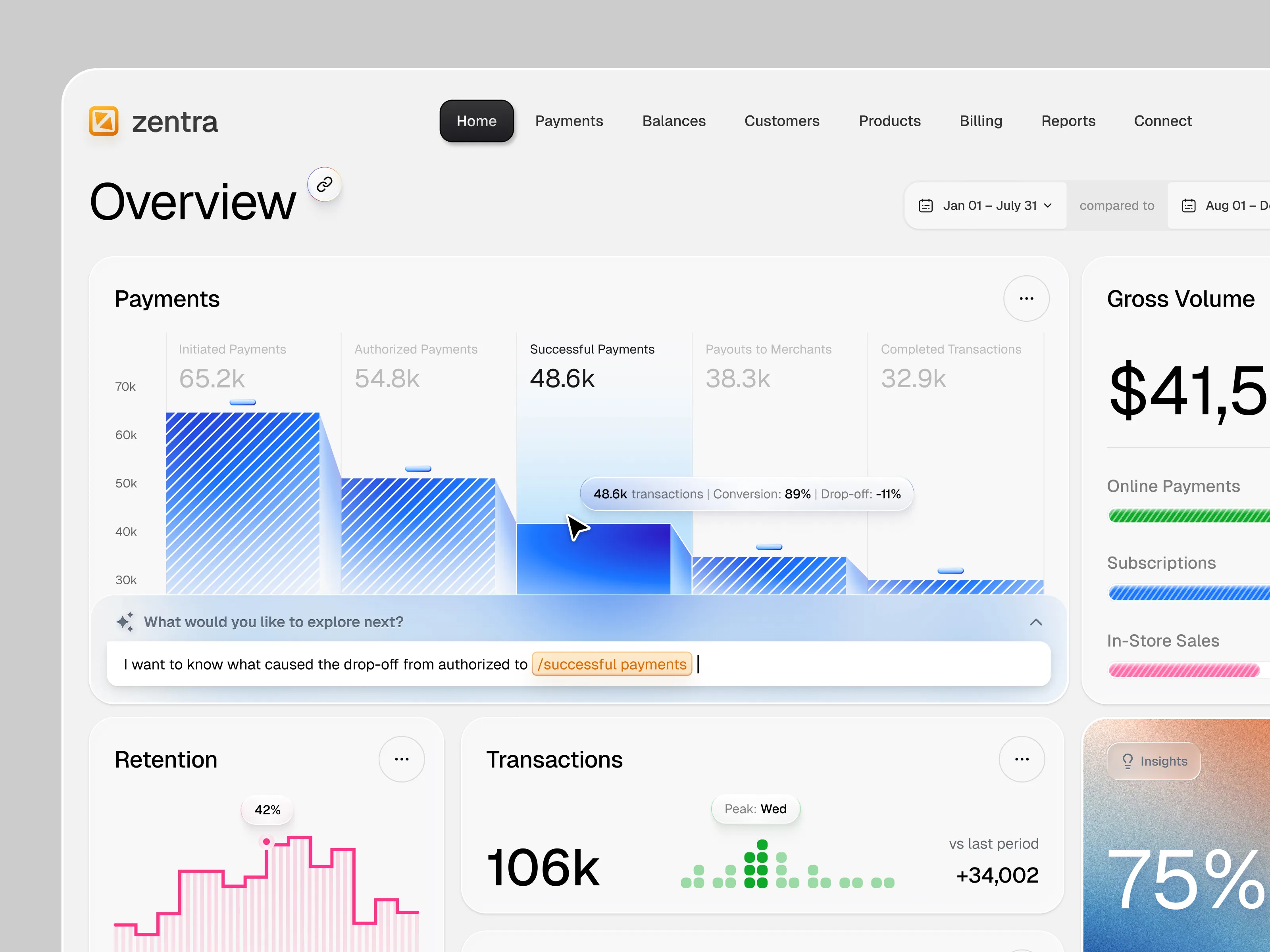
When hiring a product design partner, the portfolio is the most important evaluation tool you have. Credentials provide background. Conversations reveal personality. But the portfolio shows you how a designer or agency actually thinks — how they approach complex problems, navigate constraints, and translate business goals into products that work in the real world.

Dribbble
Written by Dribbble
Last updated
When hiring a product design agency, the portfolio is the most important tool you have for evaluation. Credentials provide background. Conversations reveal personality. But the portfolio shows you how a designer or agency actually thinks — how they approach complex problems, navigate constraints, and translate business goals into products that work in the real world.
The mistake most companies make is treating portfolios like art galleries: scanning for visual quality and moving on. A genuinely strong product design portfolio communicates something far more useful than aesthetic taste. It demonstrates strategic thinking, process discipline, and the ability to connect design decisions to measurable outcomes.
In this guide, we break down exactly what to look for when hiring a product design agency.
Table of Contents
1. A Clear Problem Definition
The first thing a strong portfolio entry should establish is context: what problem was this product designed to solve, and why did it matter?
Portfolios that jump straight from wireframes to polished visuals without setting up the problem leave you guessing whether the design decisions were intentional or intuitive. That ambiguity is itself a signal.
Look for case studies that clearly address:
- The problem statement: What specific challenge or opportunity prompted the product? A concise, well-articulated problem shows the designer can identify what actually needs solving before reaching for solutions
- The target users: Who was this designed for, and what were their real behaviors, needs, and constraints? Human-centered thinking should be evident from the start, not tacked on as a footnote
- Business objectives: What was the design meant to achieve? Strong portfolios connect design work to tangible goals: improving adoption, reducing errors, supporting monetization, and increasing retention
- Constraints: What technical, regulatory, operational, or timeline limitations shaped the solution? Designers who acknowledge real-world constraints demonstrate practicality, not just creativity
If a portfolio can’t answer these questions for its own projects, it’s unlikely the agency will ask them for yours.
2. Evidence of a Full Design Process
A polished final screen tells you what a designer can produce. The design process tells you whether they can be trusted with a complex, ambiguous product challenge.
Strong portfolios document the full journey from problem to solution, not to show thoroughness, but because the decisions made along the way are where the real capability lives.
- Goal setting: Did the designer begin with clear, measurable objectives tied to business outcomes? This signals that work is grounded in a real context rather than personal preference.
- Research and discovery: Is there evidence of user interviews, competitive analysis, or behavioral observation? Designers who base decisions on evidence rather than assumptions produce more reliable results. Look for how research insights actually influenced the direction, not just that research was done.
- Feature prioritization and product architecture: How did the designer determine what to build and in what order? Mapping user flows, structuring information, and making deliberate prioritization decisions shows systemic thinking beyond individual screens.
- Early concepts and prototyping: Strong portfolios show exploration: sketches, concept variants, alternative approaches. This demonstrates that the final solution was chosen rather than defaulted to.
- Validation and iteration: Were ideas tested with real users before development? How did feedback change the design? Iteration based on evidence is one of the clearest indicators of mature design practice.
- Execution and handoff: How did designs translate into the actual built product? Attention to implementation detail, collaboration with engineering, and post-launch monitoring all signal a designer who cares about outcomes, not just deliverables.
3. Real Impact and Measurable Outcomes
This is where many portfolios fall short and where the strongest ones stand apart.
A product design portfolio should connect design decisions to results. Not just “we redesigned the onboarding flow,” but what happened after.
User engagement and adoption growth, reduced onboarding drop-off, improved conversion or retention, successful product launches that led to further investment — these are the signals that tell you a designer understands product design as a business discipline, not a creative one.
When exact metrics are confidential, strong portfolios still provide directional evidence: qualitative user feedback, stakeholder responses, and performance improvements relative to a baseline.
The absence of any outcome data in any form is worth noting. It either means results weren’t tracked, or they weren’t strong enough to mention.
4. Demonstrated Range and Complexity
A single well-executed project can demonstrate strong thinking. A portfolio that shows range across different product types and complexity levels demonstrates something more valuable: adaptability.
Product design challenges vary enormously. Designing a focused mobile utility requires different thinking than structuring a multi-role enterprise platform.
Look for evidence of experience across environments relevant to your needs:
- Multi-feature SaaS platforms: Layered functionality, dashboards, permissions, and scalable design systems that hold together as products grow
- Marketplaces: Balancing the needs of multiple distinct user groups, often with complex transaction flows, trust mechanisms, and reputation systems
- Enterprise software: Role-based access, large-scale data management, and operational workflows where efficiency and reliability are non-negotiable
- Mobile applications: Performance, responsiveness, and cross-platform consistency across real device constraints
- Connected or hardware-enabled products. Where physical and digital interaction models must work together seamlessly
Experience with complex systems signals a designer who can think beyond individual screens. For companies planning long-term product development rather than a one-off engagement, this breadth is particularly worth evaluating.
5. Honest Reflection and Lessons Learned
One of the most revealing and most commonly absent elements in a product design portfolio is a genuine reflection on what didn’t go perfectly.
Designers who include a “what I’d do differently” section at the end of a case study demonstrate something that polished success stories can’t: intellectual honesty and a commitment to continuous improvement. It shows they evaluate their own work critically rather than treating every project as a flawless outcome.
Look for reflections that address how the project evolved from initial assumptions, which decisions proved most effective and why, where unexpected challenges emerged and how they were handled, and what the designer would approach differently with hindsight.
This kind of transparency adds credibility. It also tells you how the designer will behave when things get complicated on your project, because they always do.
6. A Portfolio That Practices What It Preaches
A product design portfolio is itself a product. The way it’s organized, navigated, and presented tells you something about whether the designer actually applies their principles to their own work.
A strong portfolio presentation should be easy to navigate, with logical project organization and a consistent case-study structure. It should be guided by storytelling that walks you through the reasoning behind decisions rather than just displaying outputs, balanced between visuals and explanation so neither overwhelms the other, and fast-loading and accessible across devices.
Beyond structure, look for authenticity. Up-to-date work that reflects current skills matters more than an extensive archive of outdated projects. A distinct perspective, original thinking, and decision-making visible throughout stand out far more than a collection of interfaces that could have been made by anyone.
Red Flags to Watch For
Some patterns in portfolios signal limited product design experience regardless of how visually accomplished the work appears:
- Case studies consisting entirely of polished final screens with no process documentation
- No explanation of the product problem or the users it was designed for
- No evidence of research, discovery, or validation at any stage
- Redesigns of popular apps or hypothetical projects without real constraints or outcomes
- Features that ignore technical feasibility or implementation realities
These portfolios may demonstrate visual talent. They rarely demonstrate the strategic thinking required for real product development.
A Quick Evaluation Framework
When reviewing multiple candidates or agencies under time pressure, these five questions cut through the noise:
- Does the case study clearly explain the product problem and context?
- Is there evidence of a structured design process — not just final outputs?
- Are design decisions supported by research or user feedback?
- Are real-world constraints acknowledged and addressed?
- Is there evidence of measurable outcomes or product impact?
A portfolio that answers all five confidently is worth a deeper conversation. One that struggles to answer more than two probably isn’t.
Final Thoughts
The patterns product design portfolio reveals, such as how a designer frames problems, makes decisions under constraints, collaborates across teams, and measures success, are the same patterns that will show up on your project.
Use the portfolio as a conversation starter. The best evaluation happens when you ask a designer to walk you through a case study in their own words: why decisions were made, what was cut and why, and what they’d change. That conversation will tell you more than any amount of time spent scrolling through screens.
The goal isn’t to find the most visually impressive portfolio. It’s to find a partner who thinks about products the way your business needs them to.
Start by browsing verified product design agencies on Dribbble or send us your Project Brief, and we’ll InstantMatch you with agencies that fit your requirements.
Written by Dribbble
Last updated